
In automotive electronic systems, the ignition coil is a core component of engine ignition. Its role is to step up the vehicle battery’s low-voltage current to a high voltage of 20–40 kV, then deliver it through the spark plug to generate a sufficiently strong spark inside the engine cylinder to ignite the air–fuel mixture and drive engine operation.
This operating environment means the ignition coil must withstand high voltage, high temperature, vibration, and severe thermal cycling from extremely low temperatures (−40°C) to high temperatures (150°C) over long periods. Under these conditions, the selection of potting materials directly determines product reliability and service life.
Starting from the key performance requirements for potting materials, this article introduces Epolab Chemical’s epoxy resin solutions developed for ignition coil potting. It covers formulation design logic, recommended curing processes, and analyses of common defects along with improvement directions.
Contents
I. Key Performance Requirements for Ignition Coil Potting Materials
Given the harsh real-world operating conditions of ignition coils, epoxy resins for potting must meet the following key performance requirements :
| Requirement | Target Specification | Rationale |
|---|---|---|
| High dielectric strength | Withstand 20–40 kV | Must tolerate the high voltage after step-up and prevent electrical breakdown |
| High-temperature thermal aging resistance | Long-term stability at 150°C | Under-hood temperatures are high; the material must maintain long-term structural integrity |
| Low coefficient of thermal expansion (CTE) | 40–50 ppm/°C | Withstand severe thermal cycling from –40°C to 150°C and reduce internal stress caused by CTE mismatch |
| Thermal cycling resistance | No cracking under repeated temperature swings | Avoid cracking from accumulated thermal stress, which compromises electrical insulation and reliability |
| Vibration resistance | Mechanical stability | Continuous vibration during engine operation requires a certain level of toughness |
| Excellent potting performance | Complete fill with no bubbles | Must penetrate complex coil structures and ensure no residual bubbles or voids |
| Chemical resistance | Resist oils and solvents | Under-hood environments involve exposure to oils; the material must tolerate chemical attack |
Why is a low CTE so important?
An ignition coil contains multiple materials (copper wire, magnetic core, plastic housing), each with a different coefficient of thermal expansion. If the potting resin has an excessively high CTE, repeated thermal cycling causes its expansion/contraction to differ greatly from other materials. Over time, the resulting thermal stress accumulates, leading to cracks and ultimately electrical insulation failure.
View Epolab Chemical's Epoxy Resin Product Line for Electrical Applications
II. Epolab Chemical’s Formulation Design Logic
To meet the stringent requirements of ignition coil potting, Epolab Chemical systematically optimizes formulations across three dimensions: the curing system, filler selection, and particle size distribution.
1. Curing system: Epoxy–Anhydride
Epolab selects an epoxy–anhydride curing system. Compared with amine curing agents, this system offers the following advantages :
- Low shrinkage during curing, effectively reducing the risk of resin cracking
- Good heat resistance and excellent moisture resistance after cure
- Outstanding electrical insulation performance, suitable for high-voltage potting applications
2. High loading of inorganic fillers
Incorporating a high loading of inorganic fillers (60–70 wt%) is the key strategy for lowering CTE :
- Lower CTE : With higher filler content, the overall CTE can be controlled at 40–50 ppm/°C, effectively reducing thermal stress accumulation during thermal cycling.
- Electrical stability : Epolab uses high-purity quartz powder as the primary filler, offering excellent electrical stability and ensuring insulation reliability under high voltage.
- Wide particle size distribution design : A broad PSD enables low shear viscosity and high penetration even at high filler loading, ensuring complete filling of gaps inside the coil.
3. Low-viscosity and Permeability design
Ignition coils have complex internal structures, and the secondary winding in particular has a high winding density—making resin flow and penetration extremely demanding. While maintaining high filler loading, Epolab designs the resin system to achieve low shear viscosity. It is typically used with vacuum (about −0.5 Torr) dispensing/potting equipment to ensure the resin fully penetrates every tiny gap.
The key role of vacuum potting
Dispensing under vacuum effectively removes trapped air within the coil structure, preventing bubbles from becoming defects after curing. Vacuum also enhances resin penetration, significantly improving filling performance—especially for dense structures such as the secondary winding.
Need a potting formulation or process recommendation? Contact Epolab's technical team
III. Recommended Curing Process
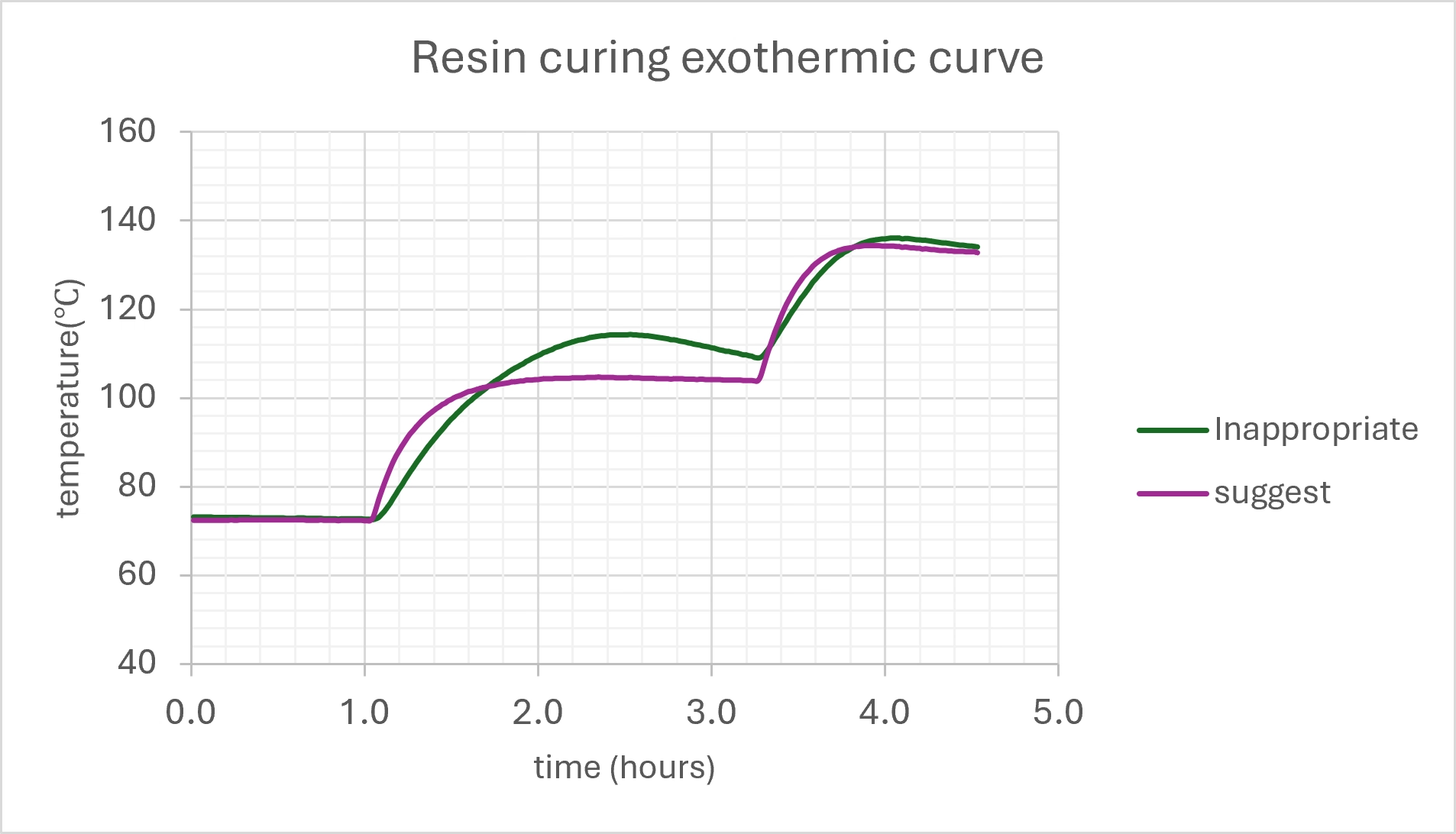
The curing procedure has a decisive impact on final product quality. Epolab recommends a “stepwise ramp” curing strategy D:
| Curing stage | Recommended temperature | Purpose |
|---|---|---|
| Pre-cure | 70–100°C | Allow the resin to gel slowly to avoid excessive shrinkage, reducing internal stress accumulation and crack risk |
| Post-cure | 130–150°C | Increase crosslink density to completion and ensure final heat resistance, moisture resistance, and electrical insulation performance |
⚠ Risks of setting the curing temperature too high
If the curing temperature is set too high, the reaction proceeds too quickly and the exotherm peak may exceed the set curing temperature, resulting in :
- Higher shrinkage and greater internal stress
- Increased likelihood of cracking, leading to electrical test failures
- Reduced long-term product reliability
Epolab recommends designing the curing program based on the principle that the resin exotherm temperature should not exceed the set curing temperature. The optimal curing profile can be jointly adjusted according to the customer’s product design and dispensing process.
IV. Epolab Ignition Coil Potting Resin: EPORITE 5502A/B
EPORITE 5502A/B is a high-performance epoxy potting resin developed by Epolab Chemical for high-reliability electronic encapsulation applications such as ignition coils. It integrates the key advantages of the formulation design described above :
| Product feature | Description |
|---|---|
| Low viscosity, excellent penetration | Effectively fills complex coil structures and reduces the risk of trapped bubbles |
| Good storage stability | Fillers are less prone to settling, simplifying production floor management |
| Low coefficient of thermal expansion (CTE) | Matches housing materials better and reduces thermal stress accumulation |
| Excellent adhesion | Good bonding to various housing materials, reducing interfacial delamination risk |
| High electrical insulation performance | Excellent dielectric withstand characteristics for 20–40 kV high-voltage potting environments |
| Thermal cycling stability | Maintains structural integrity and insulation reliability under severe thermal cycling |
View EPORITE 5502A/B and more products for electrical applications
V. Analysis and Improvement of Typical Potting Defects
Even with high-performance potting resins, quality issues can still occur if process parameters are not properly matched. The following are the two most common defect types in ignition coil potting :
1. Poor resin penetration / bubble defects
This issue typically occurs when the dispensing and curing program does not match the resin’s reaction profile: viscosity rises too quickly during potting, leaving insufficient time for the resin to penetrate dense structures such as the secondary winding, resulting in trapped bubbles or voids.
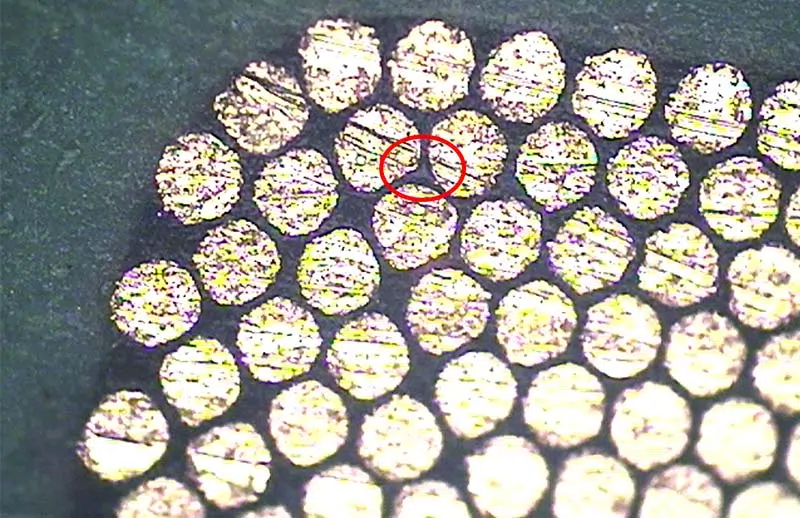
Poor penetration in the secondary winding
Improvement approach
Epolab can adjust the resin reaction speed (extend gel time) to match the customer’s equipment and curing process, ensuring sufficient penetration time before cure. It is also recommended to verify whether the vacuum system achieves the required evacuation performance.
2. Thermal cycling cracks
Cracking is the most common reliability issue in ignition coil potting. The root cause can often be inferred from the crack initiation location, and corresponding corrective actions can be taken :
| Crack type | Possible cause | Improvement |
|---|---|---|
| Through-thickness brittle fracture | Resin modulus too high / insufficient toughness | Toughen the formulation to improve flexibility |
| Interfacial cracking (along terminals / magnetic core) | CTE mismatch between resin and components | Adjust filler loading to lower CTE closer to component values |
| Corner cracking | Stress concentration + high cure shrinkage | Optimize the cure profile using a stepwise ramp to reduce shrinkage stress |
Epolab’s customization support
Cracking issues often require joint analysis of both formulation and process conditions. Epolab Chemical’s technical team can review customer-provided crack samples and process information, then fine-tune filler loading, resin toughness, or the cure profile to help identify the best-fit solution.
Experiencing potting defects? Contact Epolab's technical team to discuss
VI. Frequently Asked Questions (Q&A)
A: Standard epoxy resins are not optimized for high-voltage electrical insulation, large temperature swings during thermal cycling, and long-term thermal aging. Ignition coils operate at voltages up to 20–40 kV, undergo temperature swings from −40°C to 150°C, and experience continuous vibration. Using general-purpose potting resin greatly increases the risk of electrical breakdown or crack-induced failures.
A: Direct high-temperature curing drives the reaction too quickly and can push the exotherm peak beyond control, causing severe cure shrinkage and large internal stress buildup—ultimately leading to cracking within the coil structure. A stepwise ramp allows the resin to gel slowly at lower temperatures first; after the structure stabilizes, the temperature is increased for post-cure, effectively reducing shrinkage stress and crack risk.
A: For dense structures such as the secondary winding, vacuum dispensing/potting is a key step to ensure complete filling and eliminate bubbles. Under atmospheric pressure, air can easily become trapped inside the winding structure and cannot be expelled; after curing, residual bubbles become weak points in electrical insulation.
A: Yes. Based on the customer’s dispensing equipment, oven temperature profile, coil structure, and target reliability requirements, Epolab Chemical can adjust resin reaction speed, viscosity, and filler ratio to achieve the best match between formulation and process.
A: EPORITE 5502A/B is formulated with storage stability in mind, so fillers are less likely to settle. If the product has been stored for a long time, follow Epolab’s operating guidance to mix thoroughly before use, and confirm viscosity and appearance meet specifications prior to production.