
In composite material applications, once a product enters high-safety-demand scenarios—such as rail transportation, aerospace, or electronic equipment—material selection is no longer only about strength and weight; it directly determines “safety in the event of a fire.”
Flame-retardant prepreg (FR Prepreg) is a key material developed to meet these requirements. It integrates the lightweight, high-strength advantages of composites while incorporating flame-retardant mechanisms at the formulation level, enabling the material to suppress combustion effectively and reduce toxic smoke in fire scenarios—buying more evacuation time for passengers and personnel.
Starting from the fundamentals of the material, this article will guide you through the regulatory background, design logic, process applications, and Epolab Chemical’s technical solutions in this field.
Contents
I. What is flame-retardant prepreg?
1. What is prepreg (Prepreg)?
Prepreg is a composite intermediate in a semi-cured state, made by impregnating a resin system into reinforcing fibers (such as carbon fiber or glass fiber) in advance. Compared with traditional hand lay-up methods, prepreg offers precise resin content control, consistent fiber alignment, and high process repeatability, and is widely used in aerospace, sporting goods, and industrial structural components.
2. Where does the “flame-retardant rating” come from?
When prepreg is used in high-safety scenarios such as EU rail vehicles, the material must pass specific fire-safety certifications before it can be legally applied to vehicle components. European Committee for Standardization (CEN/CENELEC) established the EN-45545-2 standard — the core fire-performance standard for composite materials used in EU rail vehicles.
EN-45545-2 Overview
This standard classifies materials used in rail vehicles into 26 categories (R1–R26) based on installation location and component size;
It also defines three hazard levels (HL1–HL3) according to service category and evacuation difficulty.
HL3 is the highest level, indicating that even after ignition the material is less likely to generate toxic smoke, helping ensure evacuation conditions for passengers.
3. R Classes: material application locations
Below are common component categories and their corresponding test items :
| R Class | Component | Required key tests |
|---|---|---|
| R1/R2/R3 | Interior surface materials | ISO 5658-2 flame spread, ISO 5660-1 heat release, ISO 5659-2 smoke density, EN 17084 smoke toxicity |
| R4 | Light diffuser | ISO 5658-2 flame spread, EN ISO 11925-2 small flame, EN 17084 smoke toxicity |
| R5 | HVAC materials (air filter media for ventilation, heating, and air-conditioning equipment) | EN ISO 11925-2: small flame test EN ISO 5660-1: heat release test EN ISO 5659-2: smoke density / toxicity test EN 17084: smoke toxicity |
| R7 | Structural components such as driver’s cab shells | ISO 5658-2、ISO 5660-1、ISO 5659-2、EN 17084 |
| R8 | Exterior roof materials | ISO 9239-1: radiant panel test for floorings ISO 5660-1: heat release test ISO 5659-2: smoke density test EN ISO 5659-2: toxicity test EN 17084: toxicity test |
| R11/R12 | Arc-resistant insulating materials | As specified by the HL level |
| R17 | Exterior materials for the driver’s cab | As specified by the HL level |
4. HL hazard levels: determined by vehicle type and evacuation difficulty
Because evacuation conditions vary by service category, flame-retardant performance requirements for materials also differ :
| Operation category | N Standard vehicles |
A Automatic vehicles (unstaffed) |
D Double decker vehicles |
S Sleeping and Couchette cars |
|---|---|---|---|---|
| 1 | Non-underground (easy evacuation) | HL1 | HL1 | HL1 | HL2 |
| 2 | Light rail (rapid evacuation possible) | HL2 | HL2 | HL2 | HL2 |
| 3 | Metro (slow evacuation) | HL2 | HL2 | HL2 | HL3 |
| 4 | Undersea tunnel (evacuation not possible) | HL3 | HL3 | HL3 | HL3 |
In short : the more difficult the evacuation scenario, the higher the required flame-retardant level. For undersea-tunnel trains, all components—regardless of location—must meet the highest level, HL3.
II. Design features of Epolab Chemical’s flame-retardant resin for prepreg
With over 50 years of epoxy formulation R&D, Epolab Chemical faces a core challenge in designing flame-retardant resin for prepregs: ensuring the following four properties meet requirements simultaneously—yet these properties often conflict with each other at the chemistry level:
1. Four key fire-performance metrics: how can they be optimized simultaneously?
| Performance metric |
Design target | Epolab Chemical’s formulation strategy |
|---|---|---|
| Flame retardancy | Resists flame spread | Incorporates halogen-free flame-retardant systems (APP/ATP fire-retardant fillers; Nitrogen and phosphorus modified epoxy resin). During thermal decomposition, it generates flame-inhibiting gases or char/ash that helps block flame propagation. |
| Low smoke | Less smoke during combustion to maintain evacuation visibility | Uses smoke-suppressant additives such as antimony trioxide, zinc phosphate, and zinc borate, while maintaining the prepreg’s tacky (interlaminar adhesion) and handling properties. |
| Low toxicity | Non-lethal smoke to improve evacuation safety | Selects EU-accepted fire-protection materials to ensure combustion products pass the EN 17084 smoke-toxicity test, and avoids halogenated flame retardants (which can offer strong fire performance but generate toxic gases when burning). |
| Low heat release | Limits heat release to suppress fire growth | The formulation controls the heat release rate after ignition, improving survivability in fire scenarios and limiting the overall damage scope. |
Key formulation challenge
Introducing flame-retardant additives can reduce resin reaction rate, which affects prepreg handling (tacky) and curing cycle time. While meeting the four key fire-performance metrics, Epolab Chemical also ensures hot-melt impregnation quality and process feasibility—this is the core value of its accumulated formulation know-how.
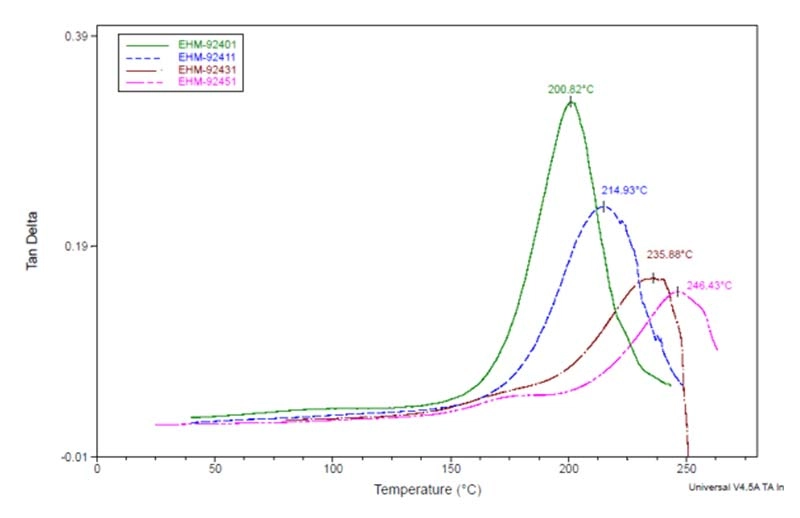
2. Tg design flexibility: from sporting goods to aerospace
Epolab Chemical use epoxy formulations with different crosslink densities. The glass transition temperature (Tg) design range spans from 100°C to 250°C, and can be customized based on the customer’s service environment and mechanical-strength requirements :
| Tg range | Type | Application scenarios |
|---|---|---|
| 100°C~130°C | Toughened | Sporting goods, consumer products |
| 130°C~200°C | Standard used | Industrial composites, rail-vehicle components |
| 200°C~250°C | High-temperature resistance | Aerospace-grade composites |
3. Widely used prepreg resin: solving temperature-sensitive handling issues
For most prepreg resin, viscosity is highly temperature-sensitive, which can cause issues in production such as :
- High ambient temperature in summer → prepreg becomes too tacky and difficult to handle
- Low ambient temperature in winter → prepreg becomes too dry with insufficient tack
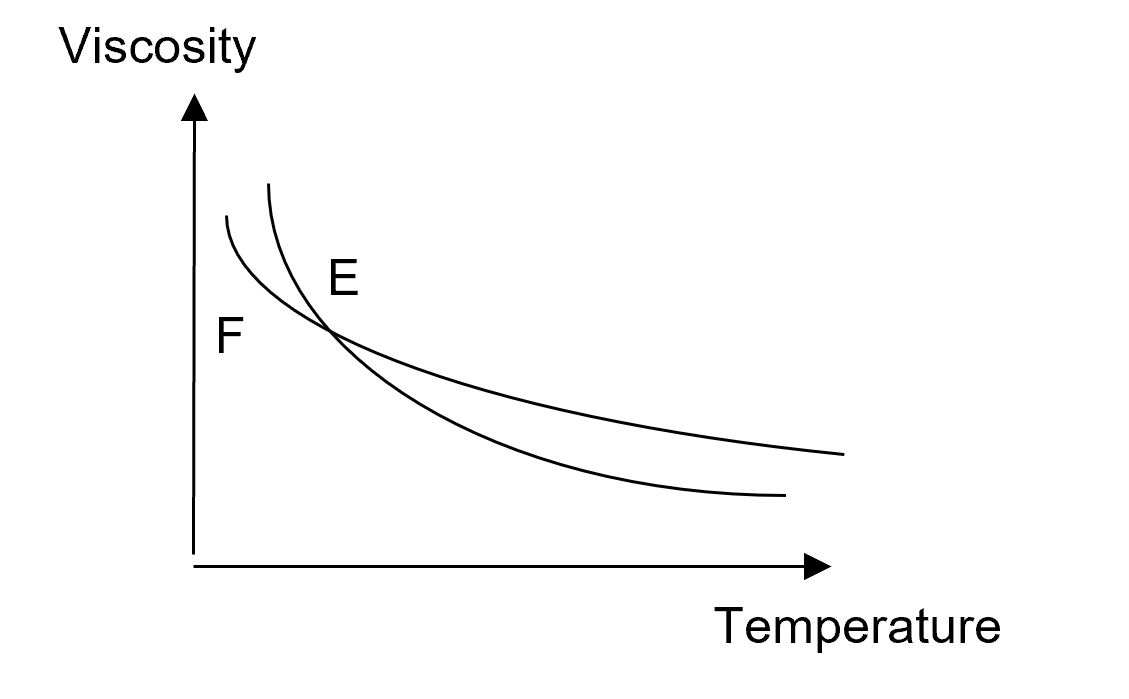
Illustration: viscosity vs. temperature
To address this, Epolab Chemical developed a widely used prepreg resin that reduces temperature sensitivity through formulation design. It helps user be less affected by ambient temperature during layup, while maintaining relatively higher viscosity at elevated temperatures—reducing resin flow rate and improving manufacturing yield.
III. Process applications and key considerations
1. Overview of supported CFRP/GFRP manufacturing processes
Epolab Chemical prepreg resin can be used with a wide range of composite manufacturing processes, accommodating different customer equipment and process conditions:DD
| Process | Notes |
|---|---|
| Hand lay-up | Suitable for small batches and complex-shaped parts |
| Resin transfer molding (RTM) | Closed-mold process suitable for mass production |
| Infusion | Suitable for large, lightweight structural parts |
| Filament winding | Suitable for pipes and pressure vessels |
| Solvent Continuous | Continuous impregnation process |
| Hot-melt process | Mainstream prepreg process with stable quality |
| Pultrusion | Suitable for long parts with a constant cross-section |
| Towpreg | Single-tow impregnation suitable for automated processes |
2. Key process considerations
- Equipment compatibility : Epolab Chemical prepreg resin can be integrated with customers’ existing equipment across various processes.
- Process stability : compatible with different RC prepreg process conditions.
- Compatible with various fibers : carbon fiber / glass fiber / Kevlar fiber…
3. Product features
- Stable tacky : the widely used prepreg resin formulation maintains consistent tacky across seasons and ambient temperatures, reducing handling errors.
- Storage conditions : excellent storage stability supports supply-chain management and reduces material loss.
- Multi-angle layup : good flexibility and tacky support multi-angle layup, suitable for geometrically complex parts.
- Stable resin flow rate : resin loss is key to lightweight performance. Epolab Chemical prepreg resin use raw materials from leading global suppliers, offering stable quality and a reliable supply chain.
IV. Verified test data: EHM-FR-042 prepreg Resin
1. Product overview
EHM-FR-042 is a flame-retardant prepreg resin developed by Epolab Chemical to meet the EN-45545-2 requirements for EU rail vehicles. Combining a high-Tg, high-stiffness epoxy formulation with carbon fiber or glass fiber reinforcement, it enables the production of composite rail-vehicle parts that comply with flame-retardant standards while remaining lightweight and mechanically robust.
2. Certification compliance results
| Component category | Achieved level | Test results |
|---|---|---|
| R7 (surface materials with an exterior exposed area ≥ 0.2 m²) | HL3 (highest) | CFE : 40.6 kW/m² MARHE : 44.06 kW/m² Ds max : 247.8 CTIG : 0.195 |
| R1 (surface materials with an interior exposed area ≥ 0.2 m²) | HL2 | CFE : 40.6 kW/m² MARHE : 44.06 kW/m² Ds(4) : 243.3 VOF4 : 446.1 mins CTIG : 0.195 |
3. Data interpretation
Test project introduction :
- CFE (critical heat flux) : the minimum heat flux required to ignite the material. Higher values indicate the material is harder to ignite.
- MARHE (maximum average rate of heat emission) : the peak average heat release rate during combustion. Lower values indicate less heat released.
- Ds max / Ds(4) (smoke density) : the optical density of smoke generated during burning. Lower values mean less smoke and better visibility for evacuation.
- VOF4 (smoke production) : the volume of smoke generated within 4 minutes; lower values are preferred.
- CTIG (smoke toxicity index) : an indicator of the toxicity of combustion gases. Lower values mean less harm to people and are critical for evacuation safety.
What this compliance means
Meeting HL3 (the highest level) for the R7 category means this prepreg can be compliant for demanding scenarios such as metros and undersea tunnels. Meeting HL2 for the R1 category covers surface-material requirements for most rail vehicles, including light rail.
V. Frequently Asked Questions (Q&A)
A: Yes. EHM-FR-042 prepreg has passed certification testing, achieving HL3 for the R7 category and HL2 for the R1 category. A complete test report is available for customer reference.
A: HL1 has the most lenient flame-retardant requirements; materials can burn more easily and generate more smoke and heat, and are typically used for parts that have less impact on evacuation. HL2 is stricter and is suitable for most interior components. HL3 has the strongest fire performance—materials are less likely to generate toxic smoke even after ignition—making it suitable for metros, undersea tunnels, and other scenarios where rapid evacuation is difficult.
A: Yes. Epolab Chemical offers customized prepreg resin formulations with Tg ranges from 100°C to 250°C. Adjustments can be made based on customer equipment operation, mechanical-strength requirements, process conditions, and target standards, and we support multiple composite manufacturing processes.
A: Epolab Chemical’s EN-45545-2 series prepregs use a halogen-free flame-retardant formulation. Although halogenated flame retardants can provide strong flame-retardant performance, they may generate toxic gases during combustion and pose risks to evacuees. This also runs counter to modern flame-retardant standards, so Epolab Chemical does not use these materials.
A: Epolab Chemical prepreg resin can be used with customers’ existing coating and impregnation equipment. Before implementation, we will confirm process parameters with the customer to ensure product quality.
A: The viscosity of standard prepreg changes significantly with temperature—often becoming too tacky in summer and too dry in winter—reducing layup stability. Widely used prepreg addresses this temperature sensitivity through formulation design, giving user a more consistent tacky experience across seasons and effectively reducing process defect rates.